
Showing posts with label big one-day moves. Show all posts
Showing posts with label big one-day moves. Show all posts
Thursday, August 15, 2019
-=Deciphera Pharmaceuticals (DCPH) : results of Phase 3 stomach cancer drug
Deciphera Pharmaceuticals (DCPH) stock nearly doubled Tuesday after the biotech company said its stomach cancer treatment benefited patients who've exhausted other options.
The biotech company is studying a drug called ripretinib in patients with gastrointestinal stromal tumors, or GIST. These patients have already worsened while undergoing at least three previous therapies — meaning they have few other options for treatment.
In the Phase 3 study, ripretinib significantly improved the amount of time patients lived with stomach cancer before worsening. Based on the data, the biotech company plans to ask the Food and Drug Administration to approve ripretinib in the first quarter of 2020.
Deciphera stock soared 80%, to 35.90, in massive volume. Shares touched their highest point since July 2018. The news sent shares of rival biotech company Blueprint Medicines (BPMC) down 3.8%, to 85.76.
Promising Stomach Cancer Treatment Results
Deciphera's drug is a precision medicine therapy. Ripretinib aims to block mutated genes that drive GIST. Currently approved drugs can't inhibit the full spectrum of primary and secondary mutations. This means the cancer can resist treatment and worsen over time.
But in the Phase 3 study, ripretinib extended the amount of time patients lived with their stomach cancer but didn't progress to a median 6.3 months. That was better than a one-month improvement in patients who received a placebo.
Ripretinib significantly reduced the risk of disease progression or death by 85% compared to the placebo, Deciphera said in a news release.
Objectively, 9.4% of patients responded to Deciphera's stomach cancer treatment vs. none of the placebo patients. That result wasn't statistically significant. The drug was also well tolerated and side effects were consistent with earlier tests.

Wednesday, July 3, 2019
-=Karyopharm Therapeutics (KPTI) prices blood cancer treatment after FDA approval
Ticker: KPTI
July 3 (Reuters) - Karyopharm Therapeutics Inc on Wednesday set a list-price for its blood cancer treatment Xpovio at $22,000 per month, following accelerated approval from the U.S. Food and Drug Administration.
Karyopharm said it expects Xpovio to become commercially available in the United States by July 10.
The list price is for all four available dosing packages, a company spokesman told Reuters.
Xpovio was approved in combination with dexamethasone for multiple myeloma patients who have received at least four prior therapies and who failed to respond to certain other treatments, the FDA said.
A late-stage study, currently testing Xpovio in combination with Takeda Pharmaceutical Co Ltd's Velcade and low-dose dexamethasone, will serve as a confirmatory trial, the company said.
Separately, in a regulatory filing https://www.sec.gov/Archives/edgar/data/1503802/000119312519189004/d694413d8k.htm on Wednesday, Karyopharm disclosed that its Chief Commercial Officer Anand Varadan, who joined the company last year, will depart effective July 5.
Xpovio's approval on Wednesday was based on results from a mid-stage study of 122 multiple myeloma patients who had previously received three or more treatment regimens, Karyopharm said.
The drug, chemically known as selinexor, binds to and inhibits a protein called XPO1, leading to the accumulation of cancer-suppressing proteins in the cells.
The FDA was to initially decide on the treatment's approval in April, but pushed back the date by three months to review additional data submitted by the company.
Multiple myeloma is estimated to cause nearly 13,000 deaths in the United States in 2019, according to the American Cancer Society.
Selinexor is also being tested in other types of cancer including lymphoma and endometrial cancer.
Karyopharm's shares closed up 36% on Wednesday.
Thursday, October 5, 2017
Aptevo Therapeutics (APVO) : Piper Jaffray initiates coverage
Piper Jaffray initiated coverage Aptevo Therapeutics. Price target $6, overweight rating.

** charts day before earnings **


Tuesday, January 17, 2017
Alcobra Pharma (ADHD) reports that the Phase 3 clinical trial of MDX in adults with ADHD missed the primary endpoint


Alcobra Pharma reports that the Phase 3 clinical trial of MDX in adults with ADHD missed the primary endpoint :
In this trial, MDX did not meet the primary endpoint of demonstrating a statistically significant difference from placebo in the change from baseline of the investigator rating of the Conners' Adult ADHD Rating Scales (:CAARS). As previously communicated, the top-line data analysis was conducted on the Full Analysis Set (n=283), which includes all randomized subjects with at least one post-baseline efficacy assessment. Consistent with previously conducted studies, MDX was generally well tolerated.
- "We are exceedingly disappointed with these top-line results. In the coming weeks, the Company intends to review the full data set from MEASURE. Consequently, we will evaluate our options and communicate our strategic plan to investors"
Thursday, September 29, 2016
Alcobra (ADHD) tumbles on FDA clinical hold
Alcobra (ADHD) announced late yesterday that the FDA has placed a clinical hold on its new drug applications for MDX for ADHD treatment.


Alcobra Ltd. (ADHD) saw its shares get halved on Thursday after the U.S. Food and Drug Administration (FDA) placed a clinical hold on its late-stage trial. Specifically, the Division of Psychiatry Products gave a verbal notice that a full clinical hold had been placed on its Investigational New Drug applications for MDX in attention-deficit/hyperactivity disorder (ADHD) and fragile X syndrome.
The clinical hold affects Alcobra’s ongoing Phase 3 clinical study of MDX in adult patients with ADHD, known as the “MEASURE” study.
The company has not yet received written notice of the clinical hold from the FDA, however, based on verbal communications, the FDA indicated that the clinical hold is due to adverse neurological findings in a pre-clinical study.
The FDA notification was not based on clinical safety data observed in the ongoing MEASURE study, which has enrolled nearly 500 subjects, or previous clinical studies involving MDX.
Alcobra said that it plans to work diligently with the FDA to seek the removal of the clinical hold.
Excluding Thursday’s move, Alcobra has underperformed the broad markets, with the stock down about 26% year to date. Over the past 52 weeks, the stock is down about 22%.
Thursday, November 12, 2015
Alarm.com (ALRM) reported earnings Tue 10 Nov 2015
** charts before earnings **


** charts after earnings **


Alarm.com beats by $0.12, beats on revs; Raises FY15 EPS and revenue guidance above CapitalIQ Consensus :


- Reports Q3 (Sep) earnings of $0.14 per share, $0.12 better than the Capital IQ Consensus of $0.02; revenues rose 26.2% year/year to $54 mln vs the $47.48 mln Capital IQ Consensus.
- SaaS and license revenue increased 27% to $36.2 million for the third quarter of 2015 compared to $28.5 million for the third quarter of 2014.
- As of September 30, 2015, Alarm.com's SaaS and license revenue renewal rate was approximately 93%.
- For the nine months ended September 30, 2015, cash flows from operations increased to $21.2 million from $6.5 million for the nine months ended September 30, 2014
- Co raises guidance for FY15, sees EPS of $0.20-$0.21 vs. prior guidance of $0.13-$0.14 and vs $0.14 Capital IQ Consensus Estimate; sees FY15 revs of $197.7-$200.1 mln vs. prior guidance of $193.9-$195.3 mln and vs $194.68 mln Capital IQ Consensus Estimate.
Thursday, May 21, 2015
Shopify (SHOP) began trading on the NYSE on 21 May 2015
- Shopify provides a cloud-based e-commerce platform designed for small- and medium-size businesses. Merchants use its software to run their business across all of their sales channels, including web, tablet and mobile storefronts, social media storefronts, and brick-and-mortar retailers.
- Its competitors include Amazon (NASDAQ:AMZN), Oracle (NYSE:ORCL) and eBay (NASDAQ:EBAY).
- In the first quarter, Shopify reported revenue of $37.3 million, up 98%, and a net loss of $4.5 million.
- The lead underwriters are Morgan Stanley and Credit Suisse. Shopify will list on the NYSE under the ticker SHOP, set to begin trading Thursday.


Shopify founder and CEO Tobi Lutke

Shopify increased the price of its IPO, indicating strong demand for shares of the provider of e-commerce services for small to medium-sized businesses.
Shopify raised its offering price to a range of 14 to 16 a share, from 12 to 14. At the midpoint, Shopify would raise nearly $116 million by selling 7.7 million shares and have a valuation above $1 billion.
The initial public offering is set to price late Wednesday and begin trading Thursday on the NYSE under the ticker SHOP.
The Ottawa, Canada-based company provides a cloud-based platform that businesses use to manage their stores across multiple sales channels, including Web, mobile, social media and brick-and-mortar locations.
Shopify says it powers over 165,000 businesses worldwide. Its customers include Tesla Motors (NASDAQ:TSLA), Budweiser, Google (NASDAQ:GOOGL) and Wikipedia.
Its competitors include Amazon.com (NASDAQ:AMZN) and Oracle (NYSE:ORCL).
In Q1, Shopify reported revenue of $37.3 million, up 98% from the year-earlier quarter, and a net loss of $4.5 million.
Shopify is one of five IPOs this week expected to raise about $1 billion in proceeds. These include e-commerce technology provider Baozun, which plans to raise $143 million by offering 11 million shares at a price range of 12 to 14 per share.
China-based Baozun provides e-commerce services designed to help its brand partners establish a market presence and launch products on official brand stores and major online marketplaces. With the offering, Alibaba Group (NYSE:BABA) will have an 18.2% stake in Baozun. It will list on the Nasdaq under the ticker BZUN and is set to begin trading Thursday.
Wednesday, May 6, 2015


Friday, February 20, 2015


Saturday, February 7, 2015


Tuesday, January 13, 2015
GoPro (GPRO) plummets after Apple granted patent for mounted cameras
GoPro's stock fell 12% on Tuesday, following a report that Apple had been granted a patent for a mounted digital camera system similar to the devices that GoPro produces.

Patently Apple reports that the U.S. Patent and Trademark Office granted Apple nearly three dozen patents on Tuesday related to the camera system, dating back to filings from 2012. According to the publication, the patents specifically note "weaknesses" in GoPro's devices.

When GoPro first filed to go public last May, the company highlighted a number of risk factors including the fact that "substantially all" of its revenue came from video camera devices, which could face competition from any number of device manufacturers including companies like Apple.
Some analysts were quick to point out on Tuesday the significantly detrimental impact Apple's plans could have on GoPro.


Patently Apple reports that the U.S. Patent and Trademark Office granted Apple nearly three dozen patents on Tuesday related to the camera system, dating back to filings from 2012. According to the publication, the patents specifically note "weaknesses" in GoPro's devices.
When GoPro first filed to go public last May, the company highlighted a number of risk factors including the fact that "substantially all" of its revenue came from video camera devices, which could face competition from any number of device manufacturers including companies like Apple.
Some analysts were quick to point out on Tuesday the significantly detrimental impact Apple's plans could have on GoPro.
** daily **
** weekly **
** heikin **
** Renko **
Tuesday, October 7, 2014
SodaStream (SODA) plunges to all-time low
NEW YORK (AP) — SodaStream says it isn't winning over enough new customers in the U.S. and reported preliminary sales that fell short of Wall Street expectations.
Over the past year, its stock has lost more than half its value.
CEO Daniel Birnbaum said Tuesday that the Israeli company's U.S. business underperformed in the third quarter because of lower-than-expected demand for its soda makers and flavors. While it successfully established a base of repeat users in the U.S., Birnbaum said SodaStream isn't attracting new users at the rate the company would like.


SodaStream has touted its machines as a cheaper, more environmentally friendly alternative to buying bottled or canned drinks such as Coke and Pepsi. It has been trying to make a splash in the U.S. and advertised in the last two Super Bowls, with the latest commercial featuring actress Scarlett Johansson. Although the machines are in just 1 percent of U.S. homes, the company has noted it's in as many as 25 percent of homes in Sweden.
Depending on the model, SodaStream machines cost between $80 and $130 and are powered by CO2 cartridges, which cost about $30 and need to be replaced after a certain number of uses.
SodaStream's machines will soon face some formidable competition, however.
Keurig Green Mountain, which is known for its single-serve coffee makers, is expected to introduce a machine for cold drinks in coming months. Earlier this year, Coca-Cola Co. announced it was buying a stake in Keurig and that it would make some of its well-known beverage brands available for the "Keurig Cold."
Over the past year, its stock has lost more than half its value.
CEO Daniel Birnbaum said Tuesday that the Israeli company's U.S. business underperformed in the third quarter because of lower-than-expected demand for its soda makers and flavors. While it successfully established a base of repeat users in the U.S., Birnbaum said SodaStream isn't attracting new users at the rate the company would like.
** daily **
** monthly **
SodaStream has touted its machines as a cheaper, more environmentally friendly alternative to buying bottled or canned drinks such as Coke and Pepsi. It has been trying to make a splash in the U.S. and advertised in the last two Super Bowls, with the latest commercial featuring actress Scarlett Johansson. Although the machines are in just 1 percent of U.S. homes, the company has noted it's in as many as 25 percent of homes in Sweden.
Depending on the model, SodaStream machines cost between $80 and $130 and are powered by CO2 cartridges, which cost about $30 and need to be replaced after a certain number of uses.
SodaStream's machines will soon face some formidable competition, however.
Keurig Green Mountain, which is known for its single-serve coffee makers, is expected to introduce a machine for cold drinks in coming months. Earlier this year, Coca-Cola Co. announced it was buying a stake in Keurig and that it would make some of its well-known beverage brands available for the "Keurig Cold."
Friday, September 5, 2014
Michael Kors announces pricing of its secondary Public Offering
Michael Kors Holdings (NYSE:KORS) shares are trading down as the maker of purses and accessories prepares a secondary public offering of more than 11.6 million ordinary shares by Sportswear Holdings, one of its principal founding stockholders, at $76.75 per share.
Shares of the company fell 5% to 75.96 in early trading in the stock market today, Friday.

Two board directors, Silas Chou and Lawrence Stroll, original majority shareholders of the Hong Kong-based company, will step down after the sale.
Shares of the company fell 5% to 75.96 in early trading in the stock market today, Friday.
Two board directors, Silas Chou and Lawrence Stroll, original majority shareholders of the Hong Kong-based company, will step down after the sale.
Tuesday, May 6, 2014
Twitter shares hit new lows as stock lock-up expires
- Shares of Twitter Inc sank 18 percent to a new low in frenzied trading on Tuesday, wiping out more than $4 billion of its market value, as early investors sold stock in the messaging service for the first time after a six-month "lock-up" expired.
- The lock-up agreement that expired this week applied to about 470 million shares, or 82 percent of Twitter's equity, held by insiders, venture capitalists and other investors. Twitter allowed one batch of shares to be sold in February, but that lockup governed only about 10 million shares, most of which were held by non-executive employees.
- Tuesday's reaction to Twitter's lock-up expiry was in sharp contrast to that of Facebook Inc in late 2012. Facebook shares jumped 13 percent on November 14 that year, when its lock-up expiry of roughly 800 million shares did not trigger an immediate wave of insider selling.
- Twitter's shares have been trading at all-time lows since April 29, when the company disclosed sagging usage metrics. Indeed, concerns about user growth and engagement levels have wiped out about half of Twitter's market value, more than $18 billion, since late December, even as it has hit revenue targets in the two quarters since it went public at $26 a share.

Until Tuesday, only about 80 million Twitter shares, a fraction of outstanding shares, were publicly traded. About 500 million closely held shares were unlocked for possible trades late Monday. They hit the market at Tuesday's opening bell.
This week's lock-up is the second and by far the largest lock-up period for Twitter, which also freed about 9.9 million shares held by non-executive employees on Feb. 15. The company sold about 70 million shares in its November 2013 initial public offering.
Vijaya Gadde, Twitter's general counsel, sold 3,914 shares on Tuesday at $39.09 apiece, according to a regulatory filing. Vice President of Engineering Christopher Fry sold 19,568 shares at the same price, according to another regulatory filing. Both still hold many shares, with Gadde's holdings totaling 861,642 shares and Fry's at 949,181 following their sales.
Several executives, including CEO Richard Costolo, said in an April 14 regulatory filing that they don't have "current plans" to sell shares.
"This should, arguably, help alleviate some of the potential pressure on the stock in the coming weeks," wrote Sterne Agee analyst Arvind Bhatia in a research note before the lock-up ended.
But Twitter stock nonetheless fell more than 16% to about 32.35 by late afternoon on the stock market today. The stock's trading about 57% off its all-time high of 74.73 on Dec. 26.
Tuesday's trading volume flew north of 100 million shares in late-afternoon trading, about 8x the company's daily average of 13.2 million shares.
Thursday, January 16, 2014
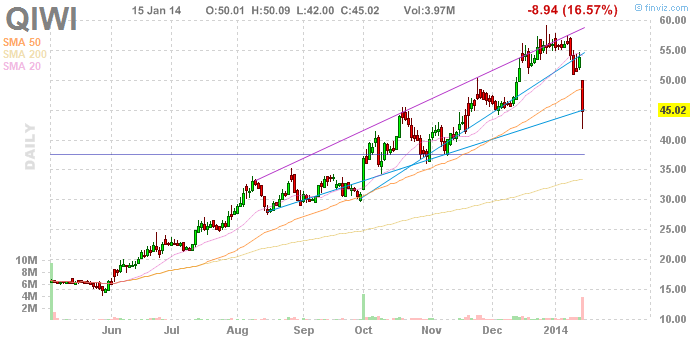
Qiwi (QIWI) drops as Russia moves to expand police powers before Olympics
Qiwi's downfall came on reports that Russia's Duma was set to vote Wednesday on a set of anti-terrorism measures. The legislation would, among other things, "oblige websites to inform authorities about their users, restrict anonymous Web payments and also broaden powers of security officers," according to the Moscow Times.
One basic aim of the bill was to restrict money laundering, seen as a key source of finance for terrorists. Proposed restrictions include holding anonymous Web payments made in Russia to below 1,000 rubles ($30) per day for one payment or 15,000 rubles ($450) per month for one user, and ban anonymous Web payments from abroad, the Moscow Times reported.
The restrictions could bear directly on Qiwi's customers, who use ATM kiosks to make online payments and money transfers.

Wednesday's loss of as much as 22% drove Qiwi shares deep below their 10-week moving average, a key line of support.

One basic aim of the bill was to restrict money laundering, seen as a key source of finance for terrorists. Proposed restrictions include holding anonymous Web payments made in Russia to below 1,000 rubles ($30) per day for one payment or 15,000 rubles ($450) per month for one user, and ban anonymous Web payments from abroad, the Moscow Times reported.
The restrictions could bear directly on Qiwi's customers, who use ATM kiosks to make online payments and money transfers.
Wednesday's loss of as much as 22% drove Qiwi shares deep below their 10-week moving average, a key line of support.
Friday, November 15, 2013
Zulily (ZU) began trading on the NYSE on 15 November 2013

Seattle-based Zulily's offering sold 11.5 million shares at $22 each, raising $253 million in total, with $140 million going to the coffers of the e-commerce company.

"The business has been profitable; we've been cash-flow positive for the past few years, says CEO and founder Darrell Cavens. "That's one of the pieces of the story that's different than what's out there. We've got growth paired with the bottom line."
Zulily has seen its revenue soar. For 2012, it reported $331 million in revenue, up 132% from a year ago. For the first nine months of 2013, it reported $438.7 million in revenue. Zulily is getting 45% of its orders from mobile.

Zulily's homepage
The e-commerce site refreshes its offers daily with promotions on curated items it says can run 50% below retail. The company has a merchandising team of 300 employees charged with finding new products at discount.
Amazon.com CEO Jeff Bezos has made no secret of ambitions for becoming an everything store, entering just about every market. The company's approach of delivering products aimed at kids is no different. The e-commerce giant acquired Diapers.com for $545 million in 2010, a deal that came after its $1.2 billion purchase of Internet shoe retailer Zappos.com.
"I think our model is really different. We're out there finding boutique products and putting them out there," says Cavens.
The company's customer base has been swelling. As of September 2013, it counted 2.6 million active customers, up from 1.6 million active customers in 2012 and 791,000 in the year before. The site was launched in January 2010.
Shares of Zulily trade on the Nasdaq under the ticker symbol "Zu."
Subscribe to:
Posts (Atom)